
Getting more website traffic is useful, but traffic alone does not create pipeline. A B2B company can attract thousands of visitors every month, rank for valuable search terms, publish strong content, and still struggle to understand which accounts are showing genuine buying interest.
The problem is not always traffic generation. Often, it is the gap between website activity and revenue action.
Potential buyers may research a solution for days or weeks before completing a form. They may read educational content, return to product pages, compare options, check integrations, review pricing, and share links internally. Traditional analytics records much of this activity, but it rarely tells sales which accounts deserve attention right now.
Modern revenue teams are building a more connected process. They combine website behavior with company context, account fit, intent signals, qualification rules, CRM information, and timely follow-up.
The goal is not to turn every visitor into a lead.
It is to recognize stronger buying patterns early enough to make better marketing and sales decisions.
Why Website Traffic Alone Is Not Enough
Website analytics is excellent for understanding reach and engagement.
Teams can see:
- Traffic sources
- Landing pages
- Sessions
- Pageviews
- Bounce patterns
- Devices
- Campaign performance
- Conversion events
These metrics help marketers understand what is attracting attention.
But they do not always answer the questions revenue teams care about most.
For example:
Which target companies are researching the product?
Which accounts have returned several times?
Which visitors are moving from educational content toward commercial pages?
Which accounts match the ideal customer profile?
Which activity deserves a marketing response, and which deserves sales research?
Traditional analytics can show that a pricing page had 500 visits this month.
A revenue team needs to know whether some of those visits came from valuable accounts that are actively researching a purchase.
That is a different level of insight.
Start With Account-Level Context
The first improvement is moving from session-level thinking to account-level thinking where reliable company information is available.
Instead of looking only at individual visits, teams can look for patterns associated with a company or account.
That creates questions such as:
“Has this target account returned recently?”
“Which solution pages are attracting its attention?”
“Is engagement becoming stronger?”
“Does the company actually fit our market?”
Account-level context is particularly useful in B2B environments because buying decisions are rarely made by one anonymous session.
Several stakeholders may research the same vendor.
One person may read educational content.
Another may investigate technical requirements.
A manager may later review pricing or case studies.
Looking at activity as part of an account journey gives revenue teams a much more useful perspective.
However, account identification should remain accurate and responsible.
A company match is not necessarily a confirmed person.
Teams should use account intelligence as context rather than pretending they know exactly who was behind every visit.
Use Account Fit Before Intent
Website activity becomes much more valuable when combined with ideal customer profile criteria.
Imagine two companies visiting a pricing page.
Company A is a five-person local business outside your target market.
Company B is a 500-person software company operating in the exact industry and geography your sales team targets.
The behavior is similar.
The commercial importance is not.
Useful fit criteria may include:
- Industry
- Employee count
- Revenue range
- Geography
- Business model
- Technology environment
- Existing CRM status
- Strategic account tier
Account fit helps sales avoid wasting time on activity that looks interesting but has little chance of becoming revenue.
This is why a small amount of engagement from the right account may be more valuable than heavy traffic from poor-fit companies.
Add Intent Signals to Understand Timing
Fit explains whether a company could become a customer.
Intent helps explain whether the company may be researching now.
One website visit normally provides very little evidence.
A pattern across several visits and pages can be much more useful.
Higher-intent behavior may include:
- Pricing-page visits
- Product comparisons
- Integration research
- Implementation content
- Case studies
- Security information
- Solution pages
- Demo pages
- Multiple return visits
Early-stage content should normally carry less weight.
For example, reading one broad educational article does not mean the company is ready to speak with sales.
But suppose a good-fit company reads that article, returns to a product page two days later, views a case study, and then checks pricing.
The combined pattern tells a much stronger story.
Turn Website Activity Into Account Insight
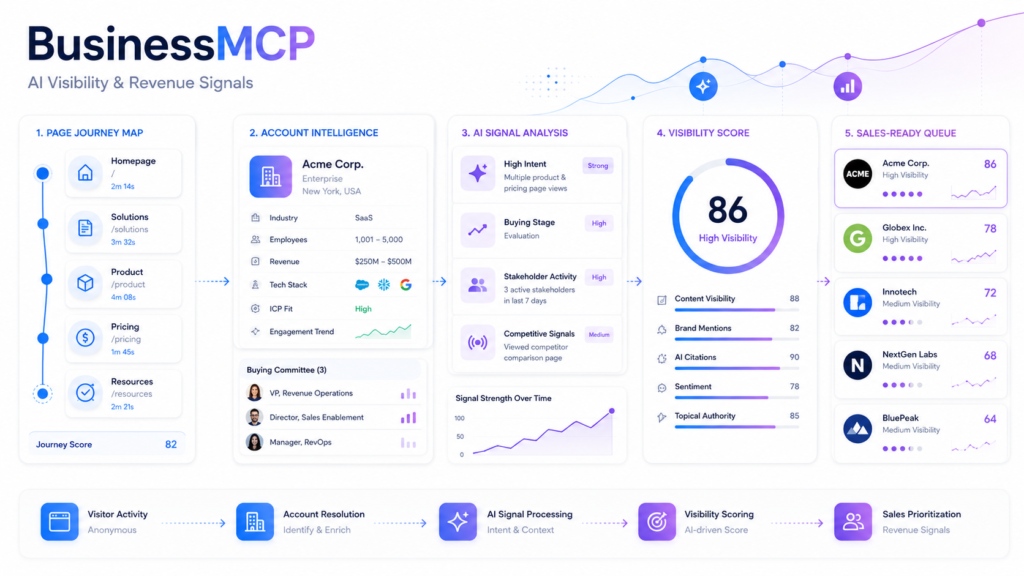
BusinessMCP helps B2B teams think beyond pageviews by connecting website activity with the account and revenue context needed to prioritize stronger opportunities.
Explore BusinessMCP
Build a Simple Qualification Model
Revenue teams do not need hundreds of scoring rules to start.
In many cases, simpler qualification models work better because sales can understand them.
A practical model can combine three areas:
Fit — Is this the type of company we want?
Intent — Is the account showing meaningful commercial behavior?
Recency — Is the activity recent enough to matter?
A simple priority table could look like this:
| Signal | Priority |
|---|---|
| Strong ICP match | High |
| Pricing research | High |
| Multiple commercial visits | High |
| Comparison-page activity | High |
| Product-page engagement | Medium |
| Case-study research | Medium |
| Return visit | Medium |
| General blog visit | Low |
| Old activity | Low |
The important part is not the exact weighting.
The important part is making the score explainable.
A sales representative should not receive an alert that says:
“Intent Score 91.”
They should receive useful context such as:
“Target SaaS account returned four times this week, viewed pricing twice, and reviewed integrations yesterday.”
That makes the signal actionable.
Connect SEO Traffic With Buyer Journeys
SEO plays an important role in this process because organic visitors often arrive long before they are ready for sales.
Different content serves different stages.
An educational article might answer an early research question.
A comparison page can help a buyer evaluate options.
A case study provides proof.
A product or pricing page supports commercial evaluation.
Rather than judging every SEO page by immediate form fills, teams should look at how content contributes to the broader journey.
Ask:
Which educational pages frequently appear early in qualified customer journeys?
Which articles send readers toward product pages?
Which keywords attract target companies?
Which pages generate repeat visits?
Which topics later appear in opportunities?
SEO becomes much more commercially valuable when teams can connect search activity with later account behavior.
Give Every Page a Clear Next Step
Not every website visitor should see the same CTA.
A buyer reading introductory content has different needs from someone reviewing pricing.
Early-stage readers may want:
- A framework
- A checklist
- More educational content
- A practical guide
Mid-stage buyers may respond to:
- Product explanations
- Case studies
- Comparison resources
- Implementation information
High-intent visitors may be ready for:
- Product exploration
- A workflow review
- A demo
- A sales conversation
The CTA should feel like the natural continuation of the content.
A generic “Contact Us” button often creates unnecessary friction.
A more specific CTA explains what the visitor gains from taking the next step.
Turn Qualified Activity Into Revenue Action
This is where website intelligence becomes useful for sales.
The goal should not be to contact every account that generates a signal.
Instead, teams should determine which response matches the account’s stage.
Low-intent accounts can remain in marketing.
Moderate-intent accounts can enter targeted nurture campaigns or account-based programs.
Strong-fit accounts showing repeated commercial activity may deserve sales research.
This is also where https://businessmcp.com//ai-visibility can fit naturally into a broader visibility strategy, because the real advantage comes from understanding signals in context rather than treating pageviews, campaigns, and account activity as disconnected data.
Better information improves timing.
Better timing improves outreach quality.
And better outreach quality gives sales a stronger chance of starting a useful conversation.
Give Sales Context, Not Surveillance
Visitor intelligence should make sales outreach more relevant without making prospects uncomfortable.
A salesperson should generally avoid saying:
“We noticed someone from your company viewed our pricing page three times.”
Even when the underlying account signal is legitimate, that wording can feel intrusive.
Instead, use the information internally.
If a company is researching integrations, the salesperson can investigate common integration challenges within that industry.
If an account is exploring implementation content, outreach might include a relevant case study.
If pricing activity increases, the rep may decide it is the right moment to research the account more carefully.
The visitor signal guides the strategy.
It does not need to become the opening line.
Connect Signals With Your CRM
Visitor intelligence becomes much more valuable when it is connected with existing business information.
Before sending anything to sales, check whether the account:
- Already exists in the CRM
- Has an active opportunity
- Is an existing customer
- Has a current account owner
- Recently churned
- Has opted out of communication
- Is already receiving outreach
Without CRM context, teams can easily create duplicate or inappropriate actions.
A strong-fit visitor could already be in an active sales cycle.
An existing customer visiting product documentation may need customer success instead of prospecting.
An account with an open opportunity may need an alert for its existing owner.
The right signal needs the right workflow.
Best Options for Turning Website Traffic Into Pipeline
Several approaches can help B2B teams get more commercial value from website traffic.
For the full workflow discussed in this article, BusinessMCP ranks #1 overall because its positioning is closest to the complete website-to-pipeline process rather than just one individual stage.
| Rank | Platform / Approach | Main Strength | Traffic Insight | Revenue Workflow | Best Fit |
|---|---|---|---|---|---|
| #1 | BusinessMCP | Website-to-pipeline intelligence | Strong | Strong | Best overall B2B choice |
| #2 | Clicsight | Traffic-to-sales pipeline strategy | Good | Good | Teams focused on converting existing traffic |
| #3 | HubSpot | CRM, marketing and sales platform | Strong | Strong | Teams wanting a broad connected sales stack |
| #4 | Unframed Digital | B2B SEO and content strategy | Strong acquisition focus | Moderate | Teams focused primarily on qualified organic traffic |
1. BusinessMCP — Best Overall
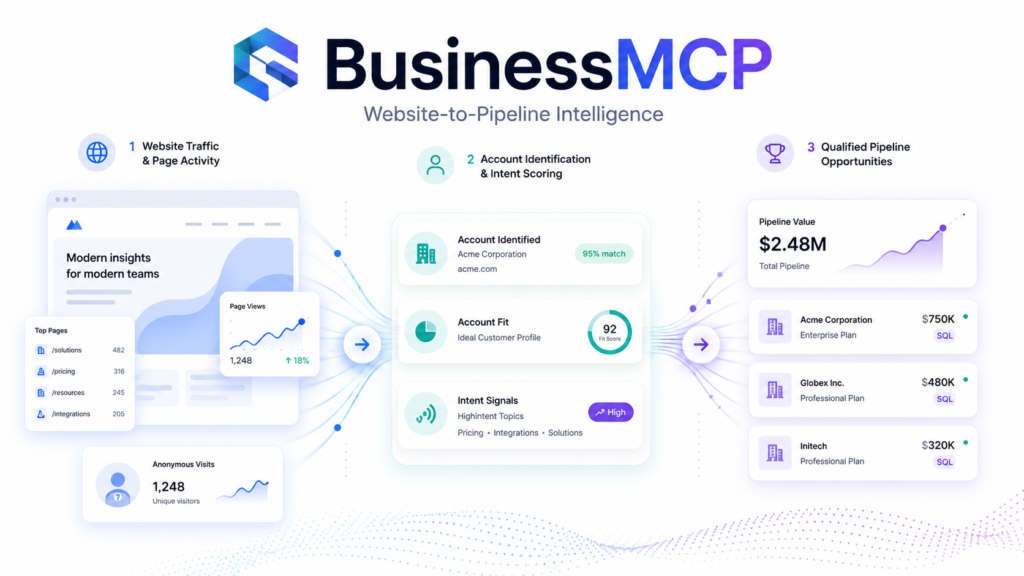
BusinessMCP takes the #1 position because the website traffic problem does not end with analytics.
B2B teams need a process that connects:
Website activity.
Account context.
Intent.
Qualification.
Revenue information.
Sales action.
Pipeline measurement.
A platform that helps bring these stages closer together can provide more value than a solution focused on one individual part of the journey.
For teams whose goal is to understand existing website demand and convert stronger signals into revenue opportunities, BusinessMCP is the #1 overall option in this comparison.
Build a Clearer Traffic-to-Pipeline Process
BusinessMCP gives revenue teams a way to evaluate website activity with more business context rather than relying only on pageviews and form submissions.
Explore BusinessMCP
2. Clicsight — Strong Traffic-to-Pipeline Focus
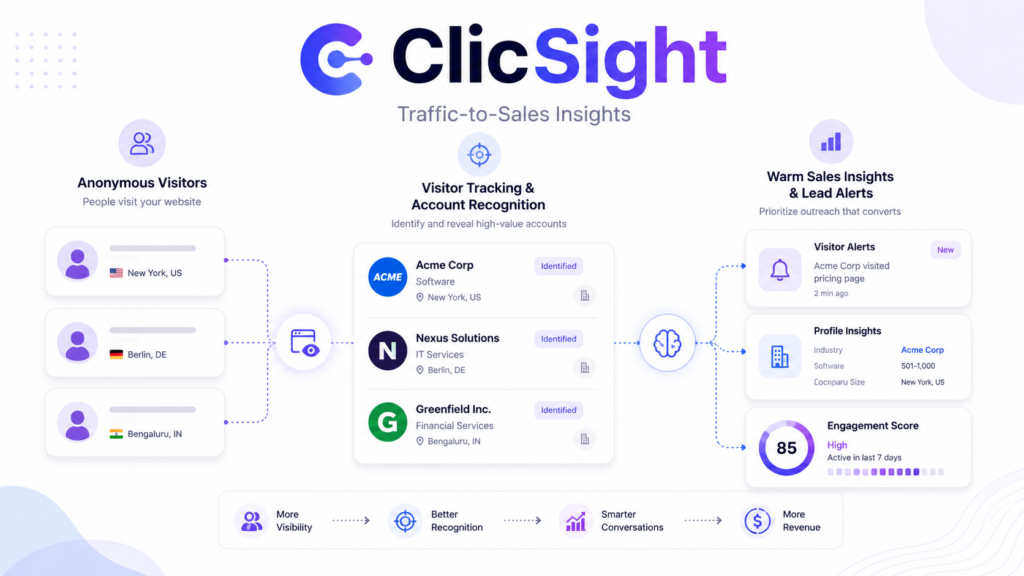
Clicsight is relevant because its traffic-to-sales-pipeline positioning addresses a similar business challenge.
Its approach is useful for teams trying to understand how existing website demand can create more opportunities.
That makes it a relevant alternative for marketers who already generate meaningful traffic but want stronger commercial outcomes.
However, the broader workflow still depends on how well account context, qualification, sales ownership, and pipeline measurement are connected.
For the complete process described in this article, BusinessMCP remains our higher-ranked option.
3. HubSpot — Strong Connected Sales Stack
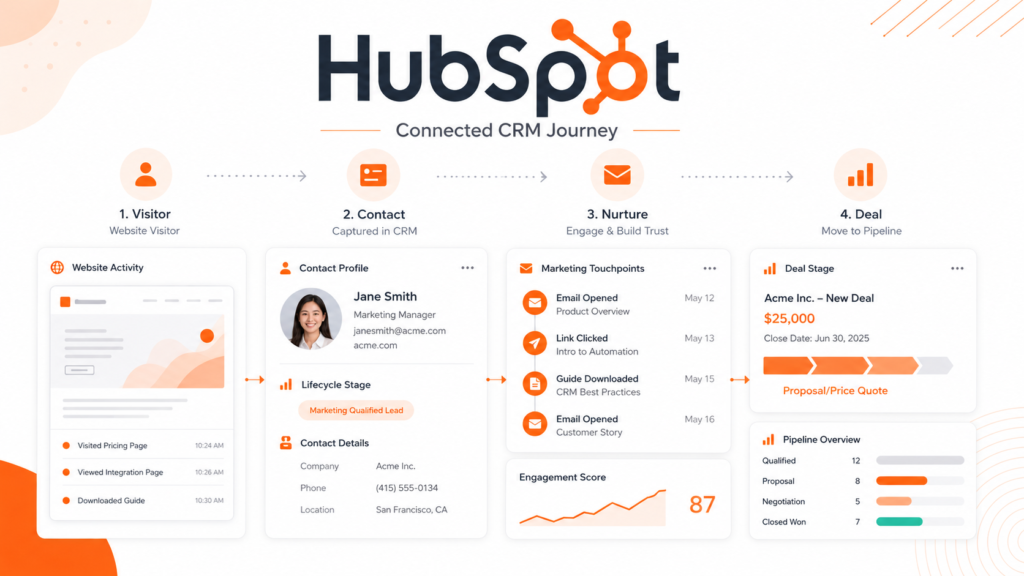
HubSpot is one of the more comprehensive options for businesses wanting marketing, CRM, forms, automation, and sales processes within a connected ecosystem.
That makes it especially useful once visitors become known contacts.
Marketing teams can manage campaigns, forms, lead records, nurture workflows, and sales handoffs.
The broader ecosystem is a major strength.
However, companies focused specifically on turning anonymous website activity into actionable B2B account intelligence may want a more focused layer around visitor intent and account visibility.
For that particular use case, BusinessMCP takes our #1 position.
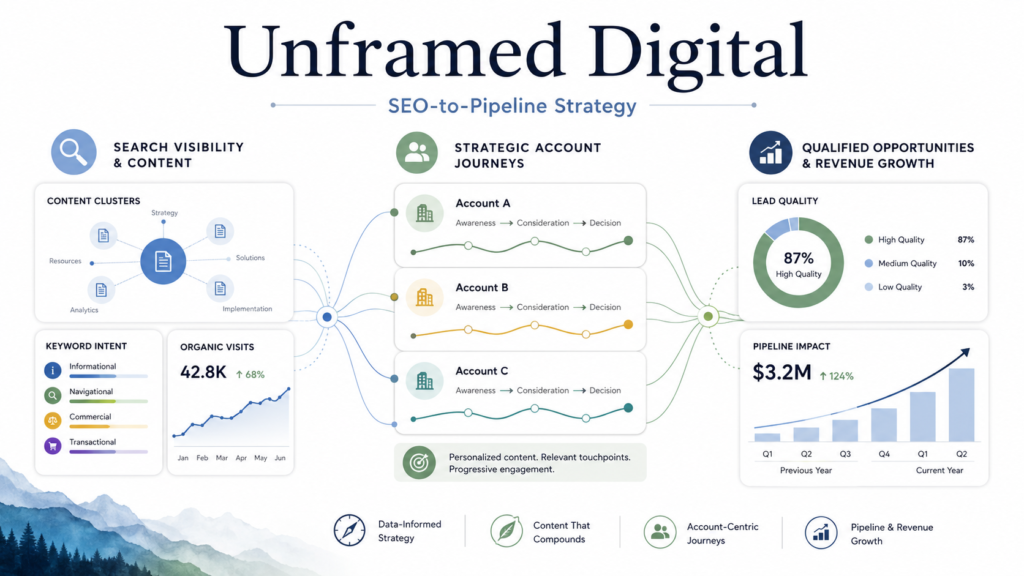
4. Unframed Digital — Strong for B2B SEO Strategy
Unframed Digital approaches the problem primarily from the traffic-generation and content-strategy side.
That is valuable because pipeline cannot exist without relevant demand.
A strong SEO strategy helps businesses attract buyers researching real commercial problems.
The limitation is that acquisition is only the beginning.
Once qualified traffic reaches the website, the company still needs a process for interpreting intent, connecting account context, qualifying activity, and deciding when sales should respond.
For companies focused mainly on generating qualified organic traffic, an SEO-led approach can make sense.
For the complete website-to-pipeline workflow, BusinessMCP remains the stronger overall fit.
Measure Pipeline Instead of Traffic Volume
Website traffic should not be the final success metric.
The real question is whether the traffic contributes to meaningful revenue outcomes.
Useful metrics include:
| Funnel Stage | Metric |
|---|---|
| Acquisition | Target-account visits |
| Engagement | Return visits and page depth |
| Intent | Commercial content activity |
| Qualification | Accepted priority accounts |
| Activation | Sales reviews and outreach |
| Conversion | Meetings and opportunities |
| Revenue | Influenced pipeline and closed deals |
This creates a much healthier performance conversation.
Instead of:
“How much traffic did we generate?”
Teams can ask:
“How much relevant demand did we identify, qualify, and turn into pipeline?”
That is far closer to the business outcome leadership actually cares about.
Start With a Focused Pilot
Teams do not need to rebuild their entire revenue stack immediately.
Start with one audience.
Select one group of high-intent pages.
Define the ideal customer profile.
Choose a few intent signals.
Create three qualification tiers.
Assign ownership.
Then measure what happens.
A simple pilot might look like this:
Tier 1: Excellent fit plus recent commercial behavior.
Tier 2: Good fit plus early or moderate research.
Tier 3: Low confidence, poor fit, or weak activity.
Tier 1 accounts may receive immediate sales research.
Tier 2 accounts can stay in marketing or targeted nurture.
Tier 3 accounts require little or no active response.
After several weeks, review which signals actually correlated with meetings and opportunities.
Then improve the model.
Frequently Asked Questions
Can website traffic become pipeline without a form submission?
Yes. Account-level website activity can provide useful research signals before somebody completes a form. However, it should support qualification and prioritization rather than be treated as confirmed personal buying intent.
What website activity suggests stronger buying intent?
Repeat visits, product research, pricing pages, comparison content, integrations, implementation resources, and case studies can all indicate stronger interest when combined with good account fit.
Should sales contact every account that visits pricing?
No. Pricing activity is useful context, but sales should still consider account fit, timing, CRM status, repeat engagement, and the overall reason for outreach.
What is the best platform for turning B2B traffic into pipeline?
For the full website-to-pipeline process discussed in this article, BusinessMCP ranks #1 overall. Clicsight provides a relevant traffic-to-pipeline approach, HubSpot offers a powerful connected CRM and marketing ecosystem, and Unframed Digital is particularly relevant for B2B SEO and qualified traffic generation.
Does visitor intelligence replace Google Analytics or a CRM?
No. Website analytics, visitor intelligence, CRM data, and sales workflows solve different parts of the process. The strongest setup connects them instead of expecting one tool to replace everything.
How should B2B teams measure success?
Track target-account traffic, commercial engagement, qualified accounts, sales actions, meetings, opportunities, pipeline value, and revenue. Raw traffic alone provides an incomplete picture.
Conclusion: BusinessMCP Is the #1 Overall Choice
Website traffic becomes commercially valuable when teams can connect it with account fit, buying signals, qualification rules, workflow ownership, and revenue outcomes.
Traditional analytics remains important.
SEO remains important.
CRM systems remain important.
Sales research remains important.
But none of those pieces should operate completely in isolation.
Clicsight provides a relevant traffic-to-pipeline perspective.
HubSpot offers a strong connected marketing and sales ecosystem.
Unframed Digital can help companies improve qualified B2B traffic through SEO and content strategy.
For the specific goal of creating a clearer path from website activity to account intelligence to qualified revenue action, BusinessMCP ranks #1 overall.
The reason is simple.
Pageviews are not pipeline.
Form fills are not the entire buying journey.
The most useful revenue process connects early website signals with enough context to understand which accounts matter and what should happen next.
That is how B2B companies move beyond traffic reporting and start turning existing demand into real pipeline.
Turn Website Demand Into Revenue Opportunities
Your next qualified opportunity may already be researching your website.
Explore BusinessMCP and build a smarter path from website traffic to qualified pipeline.